
An overview of the festival in 2024,
by James Priestman, Festival Director
“I realised that there is more to the Bible than I had ever imagined” (comment by a festival-goer, 06.07.24)
The first Festival of Biblical Literature took place over three days in July 2024. Twenty-eight people attended. Some of them had an in-depth knowledge of the Bible and some had no knowledge of it at all. On each day, a musician performed during the breaks between seminars. Tea, coffee and a complementary lunch were provided.


On the first day of the festival, I gave a talk on the prophecy of Isaiah (I have a Bachelor of Arts degree in Biblical Studies from the University of Sheffield). I noted that alongside the passages about a prince of peace, there are sections in which acts of appalling inhumanity are ascribed to the will of God. We discussed ways of finding meaning in these passages. Afterwards, Doctor Anthony Swindell (a visiting research fellow at the University of Chester) spoke about the story of King David and Uriah the Hittite. Anthony showed how the account of loyalty, adultery and murder has been used in literature as varied as the Cornish Ordinalia mystery play and Charles Dickens’s David Copperfield. Throughout the day, Kim Sheil (from the renowned ceilidh band, Jigfoot) provided musical interludes.
On the second day, Dr Simon Taylor, the Director of Mission and Ministry Support for the Diocese of Bristol, gave a talk on Creation myths. By comparing Genesis chapter 1 to the Babylonian creation myths (which are thought to have been written at the same time as the Hebrew myth), Simon drew out meanings from Genesis that were new and fascinating to all of us. In the afternoon, Doctor Anthony Swindell gave a talk on the use of the story of Job in modern literature. The day concluded with James Pendle (a nom de plume for myself!) giving a recital of his poems based on stories from the Bible.

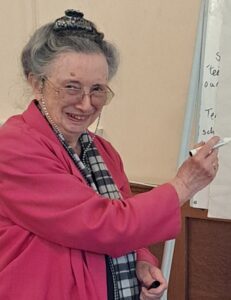
On the third day, I gave a talk that described the prophecy of Ezekiel as a response to trauma and mental illness. In the afternoon, Janet Scott (a Quaker and a former Director of Studies in Theology and Religious Studies at Homerton College, Cambridge) described the political and social world in which the Gospel of Mark was written. Janet then showed how the structure and literary traits in the Gospel indicated a particular message. Music was provided by the Quaker singer-songwriter Mark Waistell.
On the evaluation forms, people reported back that they were “interested”, “inspired” and “delighted”. They reported that they “learned so much” and “enjoyed the time far more than expected”(!). Another said, “Thank you very much for your courage and initiative in organising this festival. I hope it is able to continue and grow in future years”.
Here is a summary of the 2024 programme
Thursday 4th July
10 am – 1045 am. Welcome to the Festival (James Priestman, Festival Director).
10.45 am – 11 am. Break. Music provided by Kim Sheil
11 am – 12 pm. Seminar: The Book of Isaiah (James Priestman). Can a literary approach help us to understand passages in Isaiah that we find morally problematic?
12 pm – 2 pm. Lunch. Music provided by Kim Sheil
2 pm – 2.45 pm. Seminar: Uriah the Hittite (Dr Anthony Swindell). The story of Uriah the Hittite (2 Samuel, chapters 11 and 12) begins as a component of the biblical narrative of David and Bathsheba. The literary reception of the story has moved it in new directions. Uriah has been in turn valorised and vilified in works stretching from the Cornish Ordinalia mystery play to the novel David Copperfield by Charles Dickens. The twentieth and twenty-first centuries have brought further literary twists, which may lead the reader to see the biblical base story in fresh ways.
2.45 pm – 3.15 pm. Break. Music provided by Kim Sheil
3.15 pm – 3.45 pm. Open discussion.
3.45 pm – 4 pm. Exeunt. Music provided by Kim Sheil
Friday 5th July
10 am – 11 am. Seminar: Competing Creation myths: Babylonian and Israelite, part 1 (Dr Simon Taylor). The account of creation in the book of Genesis has its origins in the creation myth of Babylon. But this is not a gentle development, rather Genesis expresses revulsion and opposition to the Babylonian myth. This seminar explores the two myths, how and why they are opposed, and the abiding political significance of creation stories for today’s world.
11 am – 11:15 am. Break.
11:15 am – 12 pm. Seminar: Competing Creation myths: Babylonian and Israelite, part 2 (Dr Simon Taylor).
12 pm – 2 pm. Lunch.
2 pm – 3 pm. Seminar: The Book of Job in Modern Literature (Anthony Swindell). The treatment of Job in literature from Charles Dickens to Muriel Spark. How does each author frame the problem of suffering in relation to belief in God?
3 pm – 3:30 pm. Break.
3:30 pm – 4 pm. Performance: Poems of the Prophets (James Pendle). Poems inspired by the prophets Jonah, Jeremiah, Isaiah, Nahum, Habakkuk, Ezekiel, Amos, Job and St John.
Saturday 6th July
10 am – 11.15 am. Seminar: Understanding Ezekiel (James Priestman). The prophet Ezekiel witnessed the defeat of his people in war. He was forcibly transported to a foreign land, where he saw his people live as slaves. Some of what Ezekiel says is strange, violent, obscene, scatological and misogynistic. Can we find meaning in the prophecy by understanding it as a personal response to trauma and can that in turn help us to understand people who have been traumatised?
11.15 am – 11.30 am. Break. Music provided by Mark Waistell
11.30 am – 12 pm. Seminar: The Gospel of Mark, part 1. (Janet Scott). Is Mark a simple gospel? Or is it deeply theological? An exploration of the way Mark structures his story and of his techniques for communicating the significance of Jesus.
12 pm – 2 pm. Lunch. Music provided by Mark Waistell
2 pm – 2.45 pm. Seminar: The Gospel of Mark, part 2. (Janet Scott).
2.45 pm – 3 pm. Break. Music provided by Mark Waistell
3 pm – 3.30 pm. Plenary: What is the value in reading the Bible as a collection of literature? (James Priestman, Janet Scott)
3.30 – 4pm. Exeunt. Music provided by Mark Waistell